
The city of Wilmington, North Carolina, was in turmoil during the later months of 1862. After the fall of Norfolk, Virginia, to the Union Army in May of that year, Wilmington became the Confederacy’s most important port at the height of the United States Civil War. A large influx of Confederate refugees had led to extreme overcrowding, and housing was difficult to find. At the same time, a paralyzing epidemic of Yellow Fever broke out across the city, infecting thousands of Wilmington’s citizens and resulting in several hundred casualties.
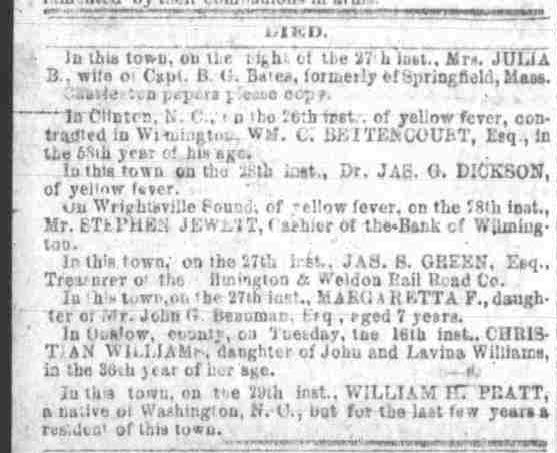
One of these unfortunate casualties was Stephen Jewett IV, a cashier at the Bank of Wilmington, who succumbed to the illness on September 28, 1862. He left behind his wife, Lucy Anna Bradley Jewett, and ten children. Like many Wilmington families during this turbulent time, Lucy decided to evacuate her family inland, and about a week before Christmas 1862, she loaded the children and many of her family’s worldly possessions onto the steamer Kate McLaurin, bound for Fayetteville via the Cape Fear River. The Kate McLaurin was carrying sixty passengers and a heavy freight, including about 700 sacks of salt. Tucked away in its holdings was a selection of beloved books from the Jewett family library.
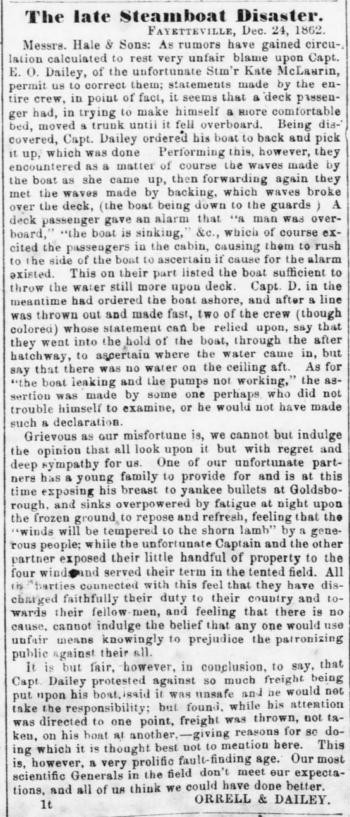
In the early morning hours of December 17, a few miles south of Elizabethtown, the boat ran aground. Conflicting reports were received as to the cause of the wreck. The December 19, 1862, edition of the Wilmington Journal attributed the wreck to "some neglect to the working of the pumps." Some said the steamer’s captain, E.O. Dailey, had had too much to drink that night, or that he simply failed to effectively maneuver the boat to safety. Speculation and rumors were so rampant in the days after the wreck that the owner of the Kate McLaurin, Mr. R.M. Orrell, published a clarifying statement in the January 1, 1863, issue of Fayetteville’s Semi-Weekly Observer. Orrell claimed that a passenger lost a trunk overboard and Dailey turned around to retrieve it, causing the boat to become caught in its own wake and take on water due to its heavy load.
The Jewett family, along with all the other passengers, ultimately made it to shore safely. Their belongings, however, did not fare so well. The Kate McLaurin’s lower deck was entirely underwater, along with most of the passengers’ furniture and clothing and the bulk of the salt shipment. These items would remain on the sunken ship for nearly two months, before the wreck was finally recovered on February 13, 1863. It was estimated that over $20,000 worth of merchandise was lost during this time. It’s not known what portion of this loss belonged to the Jewett family, but we do know of two items that survived: the family’s 1842 edition of William Dodd’s The Beauties of Shakespeare and their 1852 copy of Henry Clay’s autobiography. In 1981, Stephen Jewett IV’s great-grandson, Edward Wootten, donated a batch of his family’s books to UNCW’s Randall Library, including these two titles.
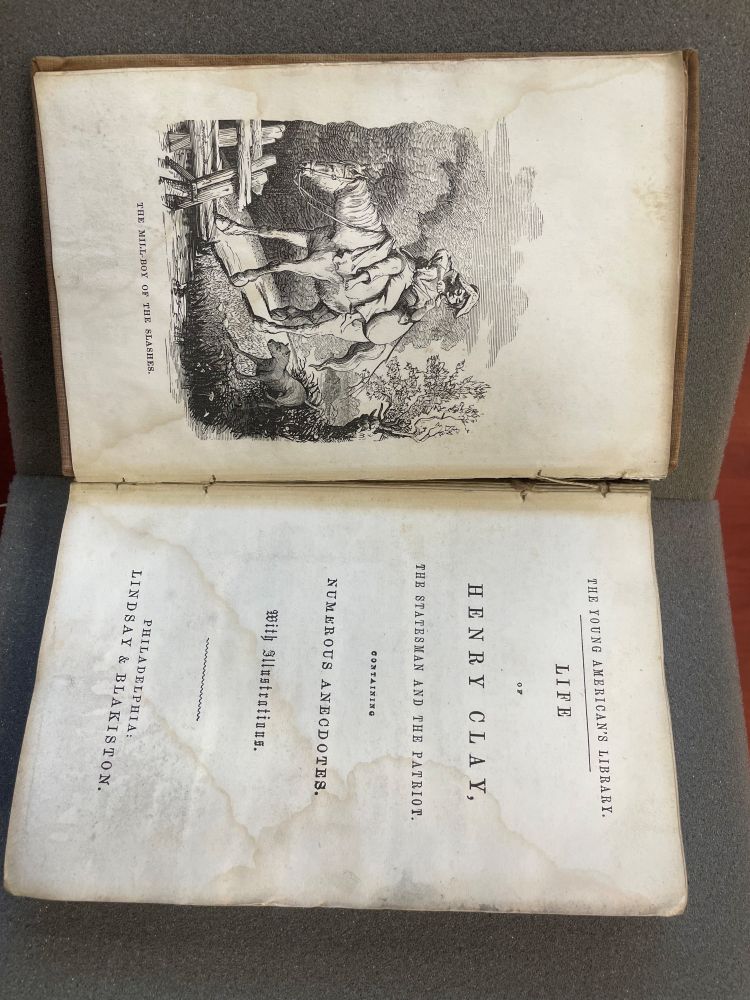
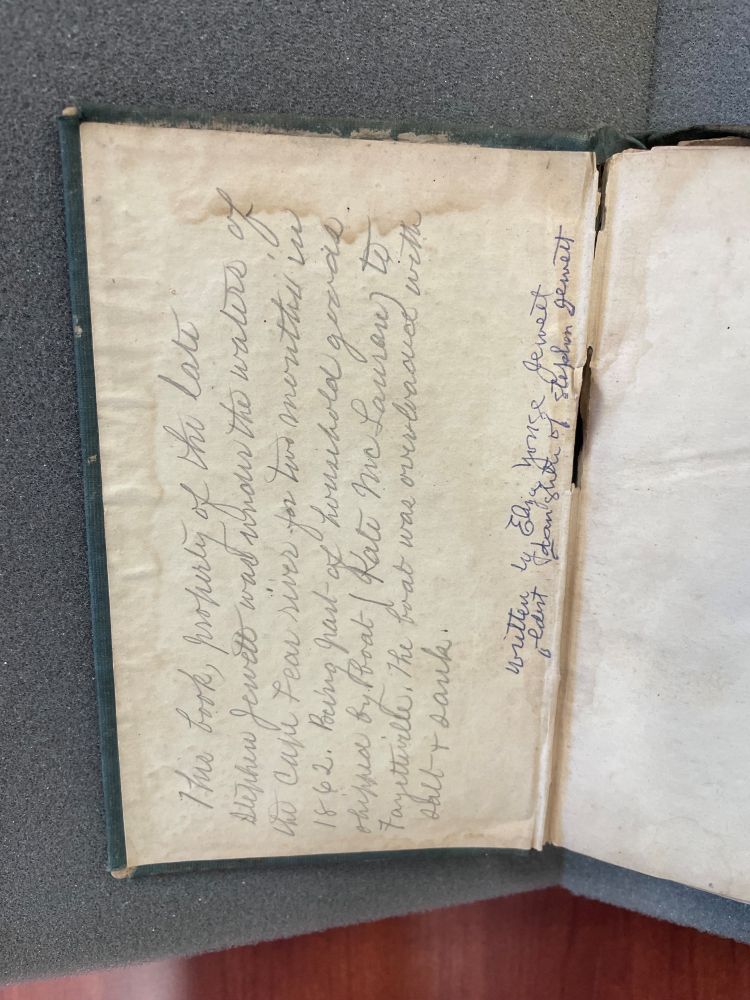
Today, they can be found in the Center’s Special Collections. Despite enduring two months in the waters of the Cape Fear River, the books are in decent shape, although evidence of repeated exposure to the river’s changing tide is discernible in their pages. Their harrowing story has been preserved in the books’ endleaves thanks to Edward’s grandmother, Eliza Yonge Jewett Wootten, the daughter of Stephen and Lucy Jewett and presumed survivor of the wreck of the Kate McLaurin.
Want to view these books in person? The Life of Henry Clay and The Beauties of Shakespeare are both available to examine anytime during our open hours.