The University of North Carolina Wilmington was one of many universities that joined the Moratorium to End the War in Vietnam on October 15, 1969. The Moratorium was a national day for teach-ins, memorial services, and demonstrations.
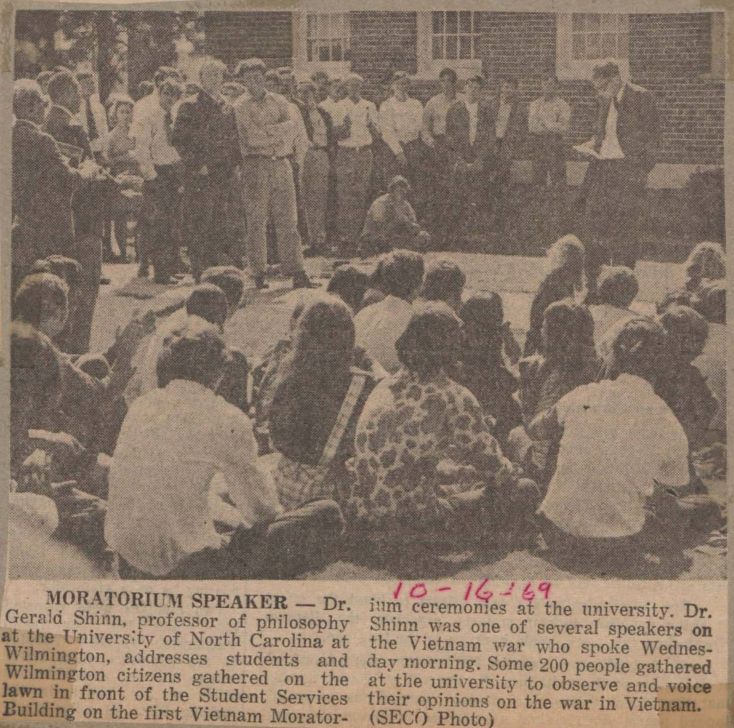
UNC Wilmington's Student Political Action Committee sponsored a memorial service attended by more than 200 students and community members. Speakers included ministers, a physician, and a UNCW professor. Some speakers voiced opposition to the Vietnam War, while a pro-war minister prioritized honoring fallen soldiers and avoiding distortion of their sacrifices.
A Star-News photographer captured UNCW philosophy professor Gerald Shinn speaking on campus to a crowd gathered to memorialize those who lost their lives in Vietnam.
Image of news articleclipping, October 16, 1969, from UNCW Advancement and University Relations Records (RG-10)
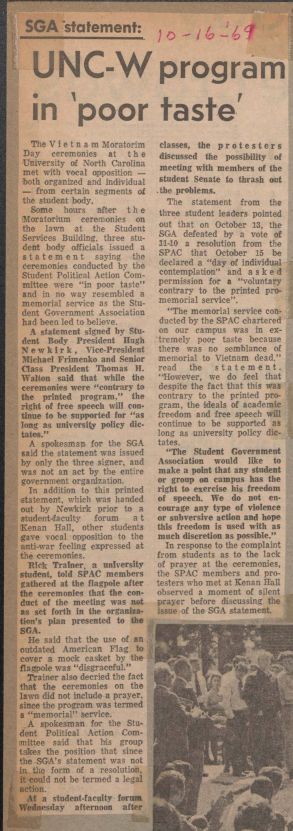
In another article, three Student Government Association leaders criticize the Vietnam Moratorium ceremony as inappropriate and misleading as a memorial service, while reaffirming support for free speech and academic freedom.
Image of news clipping about SGA response, October 16, 1969, from UNCW Advancement and University Relations Records (RG-10)
Find these articles online in the University Archives News Clipping Scrapbooks, a digital collection featuring news, events, sports, and the arts at Wilmington College and UNCW from the 1950s through the 1980s.
Scrapbook, 1969-1970, Scrapbook 11, RG-10, University of North Carolina Wilmington Advancement and University Relations Records, Center for Southeast North Carolina Archives and History.
Front cover of Apparition, undated, Center for Southeast NC Archives and History.
October is coming to an end. As the UNC Wilmington community prepares to celebrate a long-awaited Halloween holiday, the Center for Southeast North Carolina Archives and History is observing another occasion: American Archives Month. Every October, archivists share information about archives, historical records, and their value to the public. University Archives is celebrating both Halloween and American Archives Month by writing this week’s blog post about Apparition, a defunct UNCW creative magazine dedicated to all things horror, suspense, and Halloween.
Many members of the UNCW community are familiar with Atlantis, the University’s student-led creative magazine. Since 1971, Atlantis’ team has carefully selected and published the prose, poetry, artwork, and photography of talented college students from across North Carolina. Apparition, a Halloween publication, was at different times sponsored by Atlantis and the UNCW English Club, though student organizational records do not clearly indicate which group created the magazine. An article from the October 5, 1977 Seahawk newspaper mentions both organizations in a campus-wide search for “suspense or horror short stories” for the Apparition, suggesting that the magazine was a joint effort between the two student groups. Although the circumstances surrounding Apparition's creation are uncertain, the publication clearly resembles Atlantis. Like Atlantis, it features short stories, poems, artwork, and captivating front covers.
Front cover of Apparition, 1977, Center for Southeast NC Archives and History.
There are few references to Apparition in student periodicals, but an article from the October 20, 1976, Seahawk speaks positively about the magazine. According to the article, the 1975 edition of the Apparition was so popular that every copy was gone within just two hours. Perhaps students were drawn to the magazine’s pumpkin-colored front covers and the intricate—although eerie—hand-drawn illustrations. Others might have been intrigued by the spooky poems and short stories that bore titles like “The Hunted,” “There were Footsteps,” and “Peering into the Darkness.”
Although the Apparition is no longer being published, you can still view this Halloween-themed magazine by visiting the CSENCAH Reading Room on the second floor of Discovery Hall during our open hours. Or, contact us to make an appointment.
Fall is here, and so is college football season. Exuberant fans paint themselves in their team's colors, cheering crowds flood into massive stadiums, and football players walk out to the sound of an expertly drilled marching band. On other college campuses, this exciting season is in full swing, but UNC Wilmington remains quiet. While UNCW boasts many talented student athletes and championship-winning teams, football is one sport to have never graced our campus. Or has it?
Materials from University Archives reveal that UNC Wilmington once had a thriving football club. This group was not an official team; they weren't members of the National Collegiate Athletic Association (NCAA), nor were they recognized by the University's athletics department. Although the club may have been informal, student newspapers from our archives show that its members took things seriously. In their first year, the club celebrated a win streak and entered the North Carolina Club Football Association playoffs, according to a November 30, 1977, article in the Seahawk. In September 1985, another Seahawk article reported that the UNCW community needed a football team, stating that "Large crowds at home games show that the student body and community residents enjoy watching football on a fall afternoon."
UNC Wilmington's Student Government Association (SGA) was particularly invested in the Football Club, especially in the possibility of evolving it into something more. In 1979, the SGA conducted a detailed study to determine the feasibility of forming a Division III football team at UNCW, taking into consideration the demand for and cost of such a group. The study was authorized by the University's Board of Trustees, but a team was never approved. In a 1979 memorandum, the Trustees rejected the SGA's proposal due to the exceedingly high costs of creating an NCAA football team. The funding required for training facilities, scholarships, coach and assistant salaries, and insurance would have been immense. Nevertheless, the SGA and other supporters continued to assist the Football Club. In 1980, the club received $5,600 from the Student Senate, and another $2,500 from private donations, according to Board of Trustees meeting minutes.
Despite these valiant efforts, UNC Wilmington has never had an official, NCAA-backed football team. Many football-loving students have accepted this absence with plenty of humor, however. This 1981 April Fools' edition of the Seahawk, for instance, includes an articles that jokes about the Football Club receiving an enthusiastic Division I invitation from the NCAA. If you ever find yourself dreaming of football players in teal uniforms, remember that our school already has much to offer. UNCW has a plethora of competitive sports teams, student-led sports clubs, and intramural sports (including a flag football group) for everyone to enjoy.
Many of the materials mentioned in this blog post are digitized, if they have a link, and available to view online in the Library's Digital Collections. More complete citation information is below. To view these materials and other non-digitized records in-person, visit the Center's Reading Room on the second floor of Discovery Hall during our open hours. Or, contact us to make an appointment.
Before the Clean Air Act (1970), the U. S. Environmental Protection Agency (1970), and the Clean Water Act (1972), there were few regulations for industrial pollution and very limited enforcement. As a result, it was not uncommon for polluted rivers to catch fire.
For example, the Cuyahoga River in Cleveland, Ohio, was continually polluted from the 1880s through the early 1970s. It suffered a major fire in 1952. Finally, an oil spill in Santa Barbara, California pushed Senator Gaylord Nelson from Wisconsin to create the first Earth Day in 1970.
Earth Day 1971 at UNCW was a full day of special events, including programs on the impact of pollution on Southeast North Carolina. Over the years, Seahawks have raised Earth Day awareness with films, guest speakers from industry and science, environmental education, and a “filthy” photo contest.
Fifty-two years after the EPA opened, industrial pollution remains a problem for the country, compounded by our growing climate crisis. Earth Day empowers everyone to contribute to a cleaner environment. What small steps can we take to benefit our communities? For example, as consumers, we could stop throwing trash outside car windows. Our apartment complexes could provide proper outdoor trash and recycling containers for residents. Local business can discourage waste, help the bottom line, and promote our shared environment.
What action steps should we take for our planet and our people? Let us know how to end the contamination of America!
COVID-19 is not the first virus to affect American college students. We are just beginning to learn about the long-term health effects of COVID. Another life-threatening virus was polio.
First some background information from the Mayo Clinic: Polio is a contagious viral illness that in its most severe form causes nerve injury leading to paralysis, difficulty breathing and sometimes death. Poliovirus can be transmitted through direct contact with someone infected with the virus or, less commonly, through contaminated food and water. People who have polio but don't have symptoms can pass the virus to others.
Polio came to United States in 1894. The first successful vaccines—developed by Dr. Jonas Salk and Dr. Albert Sabin—were not available until the 1950s.
Dr. Albert Sabin, inventor of the oral polio vaccine / Photograph from Hauck Center, University of Cincinnati Libraries
Caring for the health of all the students at Wilmington College, Dr. Samuel Ravenel sent a letter to college president, Dr. William M. Randall, recommending that the college require polio vaccines for all students before admission (Board of Trustees minutes, 14 Jan. 1959 p. 2). After review by the executive committee, the board decided not to make the vaccine mandatory for students (Board of Trustees minutes, 11 Feb. 1959 p.3).
Later, at the Board of Trustees meeting on 26 January, 1965 (p. 3), Dr. Randall recommended that enrolled students meet “... certain physical examination entrance requirements .... This would require smallpox vaccination, tetanus toxoid, polio immunization, serology, and a chest x-ray.”
This month marks 40 years since the dedication of the Herbert Bluethenthal Memorial Wildflower Preserve at UNCW on November 8, 1974. The preserve honors the memory of Herbert Bluethenthal, a successful business-owner in Wilmington.
The university set aside about 10 acres of land behind Hoggard Hall and near the university’s existing nature trail. New trails were created in order to grant easy access to areas that included excellent examples of the native flora of Southeastern North Carolina. The preserve has been further developed over the years to offer the best examples of unique plants of the region.
The dedication ceremony featured the unveiling of the memorial to Herbert Bluethenthal by his widow, Mrs. Janet Bleuthenthal, as well as the presentation of a monument honoring contributions to botany by Dr. Bertram Wells, a noted botanist who worked in North Carolina for much of his career. Both Dr. Wells and Mrs. Bleuthenthal were honored guests at the dedication.
The preserve is intended for use both by the public as well as students in fields such as biology. The University Archives has a range of materials about Bluethenthal Wildflower Preserve and the dedication including photos, brochures, Seahawk newspaper articles, and newspaper clippings in the university’s annual scrapbooks.
Herbert's brother, Arthur, served with the French as a bomber pilot along with other Americans during World War I. He was the first North Carolinian killed in action in World War I.
In 1973, the book collection of the William M. Randall Library of the University of North Carolina Wilmington (UNCW) reached 100,000 volumes. To celebrate, the library acquired a first edition Huck Finn by Mark Twain (published in 1885) and held a special ceremony. This first edition is in Special Collections.
For comparison, according to 2012/2013 statistics, Randall Library has481,134 books.
A couple notes from the library's history:
*Wilmington College Library moved from a few rooms in Alderman Hall to its own building during winter break of 1968. It opened in January of 1969 and the official dedication was March 30.
*Randall Libray began planning an expansion in 1985, which was completed in 1987.
This model of Randall Library, circa 1985, is in University Archives in Randall Library at UNCW.
On October 24, 1993, a plaque was dedicated in Randall Library to commemorate and honor the members of the Order of Isaac Bear, an honorary organization of the University of North Carolina Wilmington. Former Chancellor William H. Wagoner founded the organization as a way to recognize members of the UNCW faculty. These members of the faculty had taught in the Isaac Bear building on Market Street, the original location of Wilmington College later UNCW, and were still employed by UNCW in 1987. The original Isaac Bear building had been an elementary school before it was home to Wilmington College. The former elementary school, Bear Hall on our current campus, and the Order of Isaac Bear were all named in honor of Isaac Bear, the brother of a local businessman.
As inscribed on the plaque, "Founded in 1988, the Order recognizes those who have demonstrated loyalty to UNCW, contributed to the academic quality of the University, or had a significant role in uniting the institution and the community." Listed are charter members Louis Adcock, Mary Bellamy, Walter Biggs, William Brooks, Thomas Brown, Joanne Corbett, Marshall Crews, Calvin Doss, Thomas Lupton, Dorothy Marshall, Duncan Randall, Gerald Rosselet, and Doug Swink. Chancellor Wagoner had an honorary membership.
In 1991, the Order expanded membership beyond faculty members who worked at Wilmington College on Market Street. Members of the staff and faculty who had contributed to the development of UNCW are invited to the Order. Associate memberships are for people who aided in the founding of the institution and for members of the Board of Trustees.
Three musical acts--the Stories, Lynyrd Skynard, and Heather--played in Hanover Hall at the University of North Carolina Wilmington. The venue had a newly installed sound system for the event. Tickets for students were $2.50 in advance or $3.50 at the door.
At the time of the performance the Stories was the biggest name of the three. They had previously released two albums both of which were well reviewed by the music world including Rolling Stone. The group had one popular hit with “Brother Louie.” Wes Knape, a Seahawk newspaper writer, wrote that this had been “a really great song when it was released; however...most of us are tired of it being played so often.”
Lynyrd Skynard had only released their first album in August of 1973 and had not built up their popularity. Even though they were not nationally recognized, music critics had already begun to hail them as the next big hit to come out of the South. This would prove correct as they would become nationally recognized shortly following their performance at UNCW.
According to students interviewed by the Seahawk, the concert did not exceed their expectations, especially the band Stories. The Seahawk published the thoughts of six students, one of whom did not even attend the concert. The students stated that the new sound system was “out of wack” as the instruments were louder than the vocals. Another complaint was the high number of high school students in the audience. One student protested the high cost of the ticket and suggested bringing in local bands to lower the cost, while another student complained that the bands brought in should be more “well known” and represent a greater variety of musical styles.
Michael Jordan came back to his hometown of Wilmington, NC, and to the game of professional basketball after retiring in 1998.
Jordan began his association with Washington Wizards as president and minority owner in 2000. In October of the same year, he brought the NBA team to the University of North Carolina Wilmington for their training camp. A sold out crowd watched the team at the end of their week-long stay in Trask Coliseum. At that time, the Wizards announced plans to return to UNCW in 2001 for their training camp. This move was anticipated by the Wilmington community, but the excitement and anticipation reached a high when Jordan announced that he would return to the NBA as a Washington Wizards player for the 2001 season.
UNCW was immediately launched into national and international news as it would serve as the location where Jordan would make his latest debut. News media from around the country, including ESPN, came to UNCW to cover the event.
Jordan played again with the Washington Wizards in Trask Coliseum in 2002. In later years, when Jordan was affiliated with the Charlotte Bobcats, UNCW welcomed this club for training camps.
Related Information:
The Seahawk student newspaper--September 7, 2000, p 18
The Seahawk student newspaper--August 30, 2001, p 17
The Seahawk student newspaper--September 27, 2001, p 16
The Seahawk student newspaper--October 4, 2001, p 13-15
The Seahawk student newspaper--October 18, 2001, p 19, 21, 24
The Seahawks student newspaper--October 13, 2005, p 9



 Dr. Albert Sabin, inventor of the oral polio vaccine / Photograph from Hauck Center, University of Cincinnati Libraries


 Michael Jordan came back to his hometown of Wilmington, NC, and to the game of professional basketball after retiring in 1998.


