The University of North Carolina Wilmington was one of many universities that joined the Moratorium to End the War in Vietnam on October 15, 1969. The Moratorium was a national day for teach-ins, memorial services, and demonstrations.
UNC Wilmington's Student Political Action Committee sponsored a memorial service attended by more than 200 students and community members. Speakers included ministers, a physician, and a UNCW professor. Some speakers voiced opposition to the Vietnam War, while a pro-war minister prioritized honoring fallen soldiers and avoiding distortion of their sacrifices.
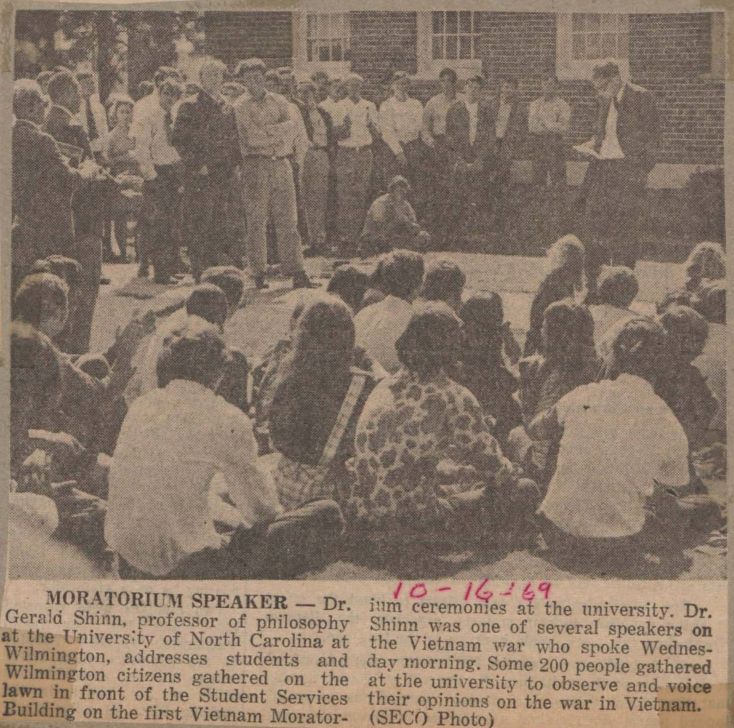
A Star-News photographer captured UNCW philosophy professor Gerald Shinn speaking on campus to a crowd gathered to memorialize those who lost their lives in Vietnam.
Image of news articleclipping, October 16, 1969, from UNCW Advancement and University Relations Records (RG-10)
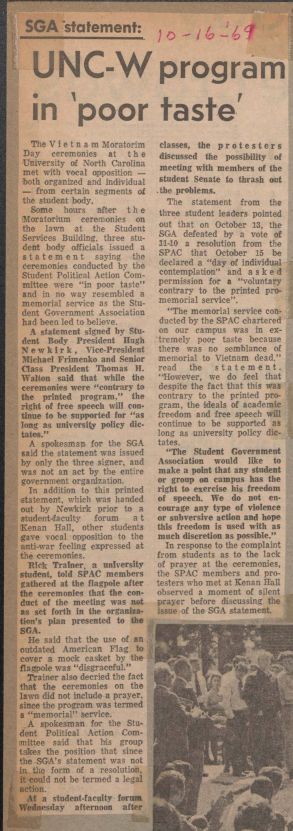
In another article, three Student Government Association leaders criticize the Vietnam Moratorium ceremony as inappropriate and misleading as a memorial service, while reaffirming support for free speech and academic freedom.
Image of news clipping about SGA response, October 16, 1969, from UNCW Advancement and University Relations Records (RG-10)
Find these articles online in the University Archives News Clipping Scrapbooks, a digital collection featuring news, events, sports, and the arts at Wilmington College and UNCW from the 1950s through the 1980s.
Scrapbook, 1969-1970, Scrapbook 11, RG-10, University of North Carolina Wilmington Advancement and University Relations Records, Center for Southeast North Carolina Archives and History.
Summer has arrived to campus, no matter what the seasonal calendar says! It has been, as it always is, a busy year of processing manuscript collections, staffing our Reading Room, teaching with primary sources and rare books, creating catalog records, growing the Center’s digital collections, navigating technology upgrades, and countless other tasks.
The Center aims to connect the people and communities and Southeast North Carolina to the sources of their history and culture by collecting materials, providing access to those materials, sharing collections with the campus and broader region, encouraging and engaging scholarship on the region, and supporting and partnering with regional cultural heritage groups. You can see some of this history and culture, as well as the work we do to make it accessible, in blog posts completed by the Center across the year, discussing a variety of topics including:
Government Information librarian Elisabeth Garner wrote a series of posts about the North Carolina Manual’s history and content, starting here.
Public Services Archivist Samantha Crisp highlighted all kinds of materials, including twoposts of fashion images in honor of Fashion Week on campus and (underrated?) film Muppets from Space, shot in town.
While the blog goes on hiatus for the summer, we will be continuing our work behind the scenes, providing access to collections through the Reading Room - by appointment - and preparing for August. I know it doesn’t seem like it but any academic librarian knows, the first day of classes is right around the corner!
National Library Week may be over, but it’s never a bad time to appreciate our library. At UNCW Library, librarians and library workers have been providing services to students, faculty, staff, and community members for over 70 years. A great deal of change and growth occurred in the past few decades. Why not take a look back?
Wilmington College, the predecessor of UNC Wilmington, spent its earliest years sharing class space at New Hanover County High School on Market Street. In 1961, the college moved to a new campus on College Road, where just three buildings accommodated the school’s faculty, staff, and students. One of those structures, the Administrative Building, housed both the administrative offices and the library. In 1965, the North Carolina General Assembly approved funding for Wilmington College’s first stand-alone library. After years of sharing limited space, the library had room to grow. The library was completed in 1969 and named William Madison Randall Library after the school’s third president. More importantly (to us library workers, at least), Randall was also a trained librarian.
In 1987, additional construction on Randall Library was finished, adding more space for seating, employee areas, and—of course—books. The 1980s also saw the creation of computerized cataloging. In Randall and in other libraries across the country, the long-lasting card catalog was slowly replaced. Materials in our archive capture just how important the card catalog was to everyday operations in the library; a Randall Library guide from the 1970s called it “in many ways…the most important tool in the Library” (pg. 8).
Smatterings of growth occurred from the 1990s to the present day, including the opening of the Technology Assistance Center in 2008 and the creation of new annual traditions like the African American Read-In, the FlashLIT writing contest, and the much-loved 48 Hour Film Competition. Significant change arrived in 2022 when construction began on a library expansion and renovation project. With the project’s completion in 2024, Randall Library became Randall Hall, while the new structure connected to Randall’s western side was dubbed Discovery Hall. Together, the two buildings—and the employees, services, technology, and resources they hold—make up today’s UNCW Library.
To learn more about the history of UNCW Library, view our Digital Collections records, which include textual materials and photographs concerning Randall Library. You can also visit our digital exhibit all about library history. It includes floor plans, a helpful timeline, and even more photographs!
The State Archives has opened registration for a June workshop that many employees on campus may find valuable: Managing Public Records for Higher Education Employees.
This free, virtual workshop provides an overview of the maintenance, retention, and disposition of public records for employees in the UNC System and the NC Community College System. It’s the perfect class for higher education employees who want an introduction or a refresher on how to take care of public records.
The time for class registration is approaching. Across campus, students anxiously plan and re-plan their schedules, meet with their academic advisors, and wildly hope they aren’t waitlisted for the one class they need to graduate. Registration has always been a stressful experience – for today’s students and for Seahawks of the past.
Before UNC Wilmington adopted the convenient registration technology used today, students had to register for classes in-person, which entailed the most tedious step of registration: waiting in line. Records from the UNCW Registration Advisory Committee explain the process further. During registration day in the 1980s, students had to enter Trask Coliseum, where they received a form and blank schedule. Getting inside took hours. Many students went to great lengths to be the first in line at Trask, as a 1984 clip from the WWAY Television News Archive shows. From the fashion and hairstyles to the Michael Jackson reference, the video is quintessentially '80s:
Inside Trask Coliseum, students waited in morelines to snag their desired classes. The process was lengthy and often unrewarding. In the 1987 Fledgling yearbook, one student writer lamented: "At registration I stand in line for three hours to get three classes out of ten which have nothing to do with my major" (pg. 76).
Even after enduring long lines and bustling crowds at Trask, students’ registration was not over. The Registration Advisory Committee outlined registration as a nine-step process that required students to trek to different locations and complete multiple forms. According to one committee document, a UNCW student in 1980 had to complete the following steps once they finished their schedule in Trask:
Go to Hoggard Hall to have their schedule checked for problems
Walk to the data entry cluster to have their classes entered in the computer
Pay tuition at Hinton James Hall
The following day, pick up their printed class schedule at the Registrar’s Office
Class registration is anxiety-inducing for college students of any era. To learn more about how past Seahawks viewed registration and how registration processes and technology changed, visit the UNCW Library Digital Collections or view our University Archives finding aids.
Sources
Registration Advisory Committee, 1980-1981, 1985-1987, Box: 13, Folder: 22. University of North Carolina Wilmington Committee and Administration Records, UA-RG-08. University Archives.
This semester, UNC Wilmington students are attending an assortment of classes. Some feature familiar topics like psychology and English, while others differ from the standard university curriculum: courses in Game Theory, Podcasting, and even Advanced Yoga Teaching are all available this year. The 2026 academic catalogue boasts a variety of topics; similarly, course selections in UNCW's past were far from limited. Class schedules in the 1940s and 1950s featured subjects still taught today, including staples like biology, history, and economics. In addition to conventional classes, however, were courses that modern Seahawks may find unusual.
During the 1940s and 1950s, students could register for a host of classes at Wilmington College (later named UNC Wilmington) through the school's Vocational and Technical Department. The department provided courses to "...supplement and broaden [students'] college preparation," according to a 1953 bulletin (pg. 54). These classes were not the first of their kind in Wilmington. Vocational and technical training had been available to the area's residents since 1940, educating skilled, sorely needed workers for the country during World War II. Wilmington College continued the trend into the 1950s with vocational class offerings like Aircraft and Engines, Refrigeration and Air Conditioning, Bricklaying, Machine Shop, Sheet Metal, Radio and Appliance Servicing, Mechanical Drawing, and more (Bulletin 1953, pg. 53-54).
Wilmington College, which was a two-year school before 1961, emphasized the importance of meeting the needs of southeastern North Carolina. The college's bulletin stated that courses prepared students for "...all phases of community life," and would satisfy the demand for both academic and vocational programs (pg. 11). The Vocational and Technical Department allowed students to pursue their academic interests while building practical skills. In the Aircraft and Engines class, for example, student learned about engine theory, aerodynamics, welding, and even woodworking (Bulletin 1953, pg. 54). A graduating exercises program from 1949 shows that one of Wilmington College's first graduates was, in fact, an Aircraft and Engines student (pg. 4).
To learn more about the Vocational and Technical Department, read over the Wilmington College bulletins and catalogues available online, or view more photographs of the school's vocational courses.
University Archives holds historic records from all divisions of the University of North Carolina Wilmington. These unique primary source materials document the history of North Carolina’s coastal public university since its founding as Wilmington College. People looking for pertinent information on higher education, Southern U.S. history, student life, athletics, civil rights, the arts, and other areas will find answers in University Archives. Find more information on coming to visit the Center for Southeast North Carolina Archives and History at UNCW Library, or check out our online resources in UNCW Digital Collections.
At University Archives, we collect official university records with historic and long-term value and provide public access to this information. To build the collection, we rely on the Records Retention and Disposition Schedule for Institutions of the University of North Carolina System. The Records Schedule helps us in University Archives, but it is a tool for everyone. Here are a few records management principles to make 2026 a great year.
Offices with custody of certain records are responsible for managing them.
According to UNCW’s Public Records Policy, custodians of public records must make records available as soon as possible after receiving a public records request.
Have you heard that you cannot destroy anything created by UNCW? While that’s true if your office is handling a public records request or is engaged in a litigation hold, it is not the case most of the time. In fact, permanent retention is a rare requirement. (If you are handling a public records request or litigation hold, contact theOffice of General Counsel for assistance.)
For everyday management of the information in your office--especially non-current information that your office no longer uses--see the Records Retention and Disposition Schedule linked above.
The Records Retention and Disposition Schedule for Institutions of the University of North Carolina System (also known as the Records Schedule or the General Schedule) is your go-to resource.
The General Schedule designates the types of records to retain permanently and the types of information to retain for shorter periods of time and then dispose. By NC general statute, this is the document to use to inform records management at UNCW and throughout the UNC system.
For help interpreting and using the Records Schedule, see the UNCW Records Management Guide.
If it’s been a while since you’ve had records management training and you know you have files in your office that you no longer need, the Center's UNCW Records Management Guide is a good place to start.
The UNCW Records Management Guide, maintained by the University Archivist, is an overview to the General Schedule. It includes more details on getting started with records management; reviewing strategies for records management and disposal; and information on managing digital records, records containing sensitive information, and permanent, archival records.
Contact the Center for Southeast North Carolina Archives and History for help with the records schedule.
Are you not sure if your information should be retained, destroyed, or archived? Have you found some old media that is perplexing? Contact us! University Archives will help you plan a review strategy and will collect records that should be transferred to the archives.
44 years ago this week, a lecture on the newly established Wiccan religion was held at UNCW. The speakers, Gavin and Yvonne Frost, were invited by psychology faculty member Antonio Puente in support of a class on the psychology of consciousness, which studied the concepts of self-awareness and the conscious mind. The Frosts’ talk was entitled “Witchcraft: The Way to Serenity.” It was extremely popular – over 175 people packed into King Hall auditorium to hear the Frosts speak. They demonstrated some traditional Wiccan healing practices and explained the basic tenets of their church, afterwards passing out newsletters to the attendees.
Article on the Frosts’ lecture, from the UNCW scrapbook, 1981-1982, in RG-10 UNCW Advancement and University Relations Records.
The Frosts were the archbishop and archbishopess of the Church and School of Wicca, which they had founded in 1968. It was the first federally recognized Wiccan church in the United States. In the early days of the church, the Frosts developed a correspondence course to teach interested followers about the Wiccan religion.
Blurb about the Frosts’ visit from the Wilmington Morning Star, 1 December 1981
The Frosts moved their church to New Bern, North Carolina, in 1974, where the church’s headquarters remained until they relocated to West Virginia in 1996. During that time, the Church and School of Wicca attracted quite a following, and a large population of Wiccan/Pagan-identifying folks still reside in or near New Bern to this day.
William M. Randall, circa 1960s, Center for Southeast NC Archives and History.
This Veterans Day, University Archives is exploring the rich history between the military and the University of North Carolina Wilmington.
UNC Wilmington's military connections emerged in the aftermath of World War II, before the College had even opened. The G.I. Bill was signed in 1944, offering significant financial support to returning soldiers who sought university education. North Carolina, seeing the influx of veteran enrollment, established temporary college centers across the state. In 1947, two centers were created in the state's Southeastern region - reflections of the importance of veterans as well as the racial segregation of the time: Wilmington College, for white students, and Williston College, for Black students. Both colleges provided higher education to veterans, eventually becoming the one UNCW we know today. Original documents related to the colleges, their administrations, and their student veterans are available in our Committee and Administration Records, as well as in our Academic Affairs Records.
ROTC practicing a close order drill, circa 1980s, Center for Southeast NC Archives and History.
Since its time as a college center, the University has educated and employed many veterans, some of whom are integral to understanding UNCW history. John T. Hoggard, a veteran of the Spanish-American War and World War I, served as the second president of Wilmington College from 1949 to 1958. A World War II soldier, William M. Randall, acted as the College's third president and created the University motto, discere aude, still in use today. William DeLoach, William H. Wagoner, James Marshall Crews, and James Leutze are just a few other veterans who also served as University leaders.
UNC Wilmington extended its support to veterans, particularly student veterans, with the creation of the Office of Veterans Affairs (OVA) in 1974. According to academic catalogues from the 1970s, the OVA was responsible for veteran success on campus, from outreach and recruitment to counseling and educational support. In the 1980s, UNC Wilmington furthered its efforts by developing an Army Reserve Officers' Training Corps (ROTC) program. Records in University Archives show that the ROTC program began as a temporary cross-enrollment arrangement. By 1984, however, the University was granted host status, allowing UNCW ROTC to directly provide training, education, and support to future military veterans. The ROTC program no longer exists on campus, but University Archives holds a plethora of materials related to UNCW's ROTC history and the work of students in the organization. Items in the collection include scrapbooks, awards, challenge yearbooks, brochures, handbooks, annual reports, and marketing materials, among other items; see the finding aid for a full listing of records and dates covered.
ROTC commissioning event, circa 1980s, Center for Southeast NC Archives and History.
Today, UNC Wilmington continues to support its military-affiliated students. Students who are veterans, active-duty, or related to service members receive guidance from the Office of Military Affairs (OMA). UNC Wilmington has ranked in the top 30 schools for military veterans since 2022 because of the OMA's efforts. In 2024, UNCW was named the #1 school in North Carolina for veterans.
To learn more about the historical connections between UNC Wilmington and the military, visit the CSENCAH Reading Room on the second floor of Discovery Hall during our open hours or contact us with questions or to make an appointment.
Front cover of Apparition, undated, Center for Southeast NC Archives and History.
October is coming to an end. As the UNC Wilmington community prepares to celebrate a long-awaited Halloween holiday, the Center for Southeast North Carolina Archives and History is observing another occasion: American Archives Month. Every October, archivists share information about archives, historical records, and their value to the public. University Archives is celebrating both Halloween and American Archives Month by writing this week’s blog post about Apparition, a defunct UNCW creative magazine dedicated to all things horror, suspense, and Halloween.
Many members of the UNCW community are familiar with Atlantis, the University’s student-led creative magazine. Since 1971, Atlantis’ team has carefully selected and published the prose, poetry, artwork, and photography of talented college students from across North Carolina. Apparition, a Halloween publication, was at different times sponsored by Atlantis and the UNCW English Club, though student organizational records do not clearly indicate which group created the magazine. An article from the October 5, 1977 Seahawk newspaper mentions both organizations in a campus-wide search for “suspense or horror short stories” for the Apparition, suggesting that the magazine was a joint effort between the two student groups. Although the circumstances surrounding Apparition's creation are uncertain, the publication clearly resembles Atlantis. Like Atlantis, it features short stories, poems, artwork, and captivating front covers.
Front cover of Apparition, 1977, Center for Southeast NC Archives and History.
There are few references to Apparition in student periodicals, but an article from the October 20, 1976, Seahawk speaks positively about the magazine. According to the article, the 1975 edition of the Apparition was so popular that every copy was gone within just two hours. Perhaps students were drawn to the magazine’s pumpkin-colored front covers and the intricate—although eerie—hand-drawn illustrations. Others might have been intrigued by the spooky poems and short stories that bore titles like “The Hunted,” “There were Footsteps,” and “Peering into the Darkness.”
Although the Apparition is no longer being published, you can still view this Halloween-themed magazine by visiting the CSENCAH Reading Room on the second floor of Discovery Hall during our open hours. Or, contact us to make an appointment.