The University of North Carolina Wilmington was one of many universities that joined the Moratorium to End the War in Vietnam on October 15, 1969. The Moratorium was a national day for teach-ins, memorial services, and demonstrations.
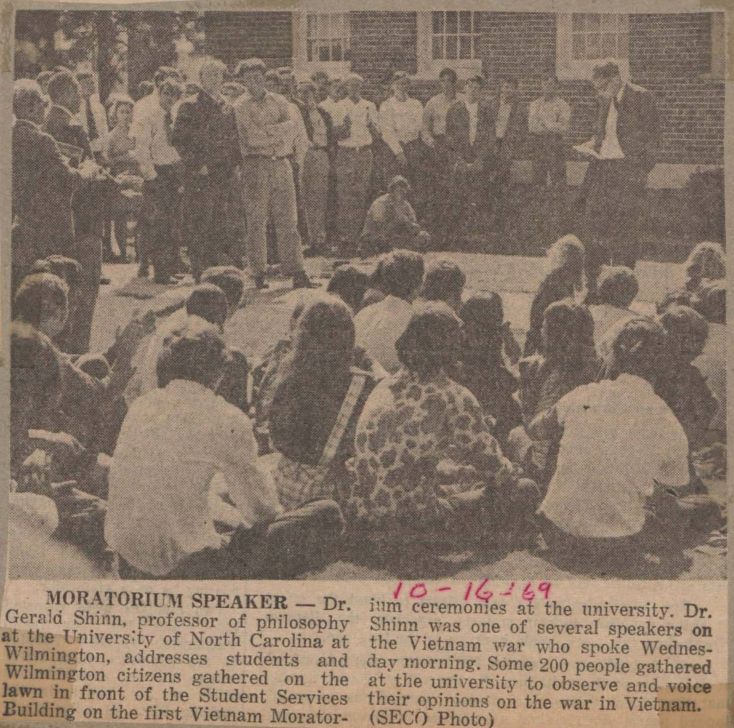
UNC Wilmington's Student Political Action Committee sponsored a memorial service attended by more than 200 students and community members. Speakers included ministers, a physician, and a UNCW professor. Some speakers voiced opposition to the Vietnam War, while a pro-war minister prioritized honoring fallen soldiers and avoiding distortion of their sacrifices.
A Star-News photographer captured UNCW philosophy professor Gerald Shinn speaking on campus to a crowd gathered to memorialize those who lost their lives in Vietnam.
Image of news articleclipping, October 16, 1969, from UNCW Advancement and University Relations Records (RG-10)
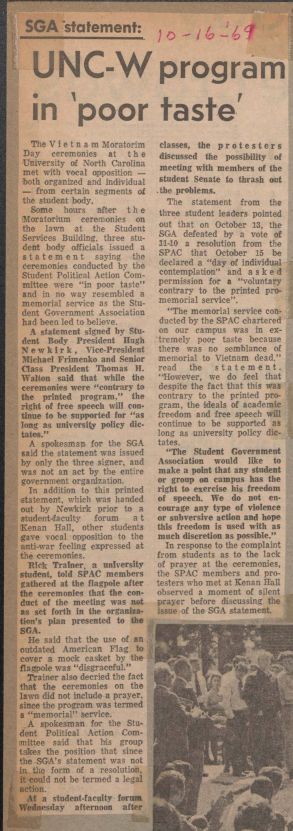
In another article, three Student Government Association leaders criticize the Vietnam Moratorium ceremony as inappropriate and misleading as a memorial service, while reaffirming support for free speech and academic freedom.
Image of news clipping about SGA response, October 16, 1969, from UNCW Advancement and University Relations Records (RG-10)
Find these articles online in the University Archives News Clipping Scrapbooks, a digital collection featuring news, events, sports, and the arts at Wilmington College and UNCW from the 1950s through the 1980s.
Scrapbook, 1969-1970, Scrapbook 11, RG-10, University of North Carolina Wilmington Advancement and University Relations Records, Center for Southeast North Carolina Archives and History.
National Library Week may be over, but it’s never a bad time to appreciate our library. At UNCW Library, librarians and library workers have been providing services to students, faculty, staff, and community members for over 70 years. A great deal of change and growth occurred in the past few decades. Why not take a look back?
Wilmington College, the predecessor of UNC Wilmington, spent its earliest years sharing class space at New Hanover County High School on Market Street. In 1961, the college moved to a new campus on College Road, where just three buildings accommodated the school’s faculty, staff, and students. One of those structures, the Administrative Building, housed both the administrative offices and the library. In 1965, the North Carolina General Assembly approved funding for Wilmington College’s first stand-alone library. After years of sharing limited space, the library had room to grow. The library was completed in 1969 and named William Madison Randall Library after the school’s third president. More importantly (to us library workers, at least), Randall was also a trained librarian.
In 1987, additional construction on Randall Library was finished, adding more space for seating, employee areas, and—of course—books. The 1980s also saw the creation of computerized cataloging. In Randall and in other libraries across the country, the long-lasting card catalog was slowly replaced. Materials in our archive capture just how important the card catalog was to everyday operations in the library; a Randall Library guide from the 1970s called it “in many ways…the most important tool in the Library” (pg. 8).
Smatterings of growth occurred from the 1990s to the present day, including the opening of the Technology Assistance Center in 2008 and the creation of new annual traditions like the African American Read-In, the FlashLIT writing contest, and the much-loved 48 Hour Film Competition. Significant change arrived in 2022 when construction began on a library expansion and renovation project. With the project’s completion in 2024, Randall Library became Randall Hall, while the new structure connected to Randall’s western side was dubbed Discovery Hall. Together, the two buildings—and the employees, services, technology, and resources they hold—make up today’s UNCW Library.
To learn more about the history of UNCW Library, view our Digital Collections records, which include textual materials and photographs concerning Randall Library. You can also visit our digital exhibit all about library history. It includes floor plans, a helpful timeline, and even more photographs!
The book Just Yesterday: North Carolina People and Places features photography produced by Bruce Roberts, described as "a prominent twentieth-century photographer." These prints cover everyday life, from ordinary tasks to people doing all kinds of work, capturing "the essence of life in North Carolina in the mid-to late twentieth century." The photographs have been divided by four geographic regions across the state of North Carolina: the Outer Banks, the East, the Piedmont, and the Mountains. For those who grew up in North Carolina or have lived here for quite some time, several of the images may be recognizable and nostalgic.
Beginning with the Outer Banks, there are countless photos of this unique area of our state. Some of the photos include images of many fishermen partaking in a time-honored tradition to our coastal areas. The Cape Hatteras lighthouse features prominently over a few pages, along with the Bodie Lighthouse surrounded by a light blanket of rare snow.One Stacy Franklin Guthrie was highlighted in a photograph, depicting the elderly gentleman next to one of many boats he crafted on his own property. Images from shrimping and fishing boats are brilliantly captured in both black and white and color, depicting large net catches of the highly valued seafood.
Salvo Post Office, Outer Banks, NC, p.7
Closer to Wilmington's geographic area of southeastern North Carolina, the book next focuses on the East, with a full-page black and white photograph taken in Robeson County from 1959. It shows a father and son walking together next to a large oak tree, as the father holds a hoe. In his description, Roberts states that the son will assuredly use newer methods of farming, namely a tractor. Let us not forget that tobacco was once king in North Carolina, with photos depicting many instances of this crop and how it was farmed. Men walking through tobacco houses at an auction, women separating dried tobacco leaves as a result of the "flue-cured" process, and stories of men placing bricks in the bottom of their tobacco piles since "it was paid for by the pound."
The battleship USS North Carolina is also featured, in a photograph from 1961 returning to Wilmington "after being mothballed since World War II in the naval reserve fleet." Roberts talks about the statewide fundraising, where "thousands of students contributed dimes and quarters to the effort" of bringing the ship to Wilmington.
Another notable photo in this section devoted to "the East" depicts Suzy Sterling, a white 18-year-old college student with a very young African American child sitting on her lap, staring into each other’s eyes. Sterling had "joined ninety-nine other North Carolina college students in the opening battle of a statewide interracial war on poverty." The photo was taken in Rockingham, NC, in an old two-room schoolhouse in which Sterling had been sent to work in a daycare, playing with and teaching the young students. The little boy in her lap had just fallen and was seeking attention when Sterling pulled him up onto her knees and they proceeded to have a staring contest.This image went on to be included as a full page "in the state of North Carolina’s official history book for eighth graders in 1992" and Roberts exhibited it at the Museum of Modern Art in New York City.
This book shares beautiful photos of people and places throughout the Piedmont and mountain areas of our state. It is worth a leisurely look at, to appreciate the varied aspects of our state’s history over the last several decades.
April marks when spring awakens gardens across Southeast North Carolina. By the first or second week of the month, the Azaleas are at or just past their peak. The roses have leafed out, and some early bloomers like “Lady Banks” begin to show off their spectacular yellow flowers. Spring and summer blooming perennials burst out of the ground, while the deciduous shrubs start to form buds and leaves on their twiggy stems.
Courtesy of the Star-News Image Archive, property of Gannett Media Corp.
The gardener’s chore list is long in April. Weeding, pruning, raking, fertilizing, mulching, and the spreading of pine straw - these are just some of the many tasks for willing hands. For the sake of time management, Wilmington horticulturist Henry Rehder, Jr. conveniently lays these tasks out in a day-by-day format in his book, Creating a Beautiful Landscape. Note, for example, that on this day – April 16th – it is time to fertilize the oleanders with 5-10-10 fertilizer.
It’s during this time of year that amateur and professional gardeners alike also flock to local nurseries, flush with beautiful, healthy-looking plants and flowers. The possibilities are seemingly endless when surrounded by shades of green, pink, white, and purple. But, as many longtime SENC-landers will attest, the growing environment in this region is formidable - brutal summer heat, unpredictable winters, drought, and torrential rain. Add in other factors, such as shade availability and directional orientation of the garden, and suddenly, gardening in Southeast North Carolina can seem like a science experiment that you didn’t sign up for.
To account for these difficulties, the advice of Wilmington master gardener and author Barbara Sullivan, is simple(ish): “Grow what does best wherever you happen to garden.” Fortunately, Sullivan’s book, Garden Perennials for the Coastal South, provides detailed recommendations for the best plant selections for this area based on a variety of factors. Aptly, she also identifies which plants are not suitable for the local environment. Astilbe – that enticingly fluffy perennial seen in garden centers this time of year – for example, is listed in a section of the book titled “Perennials to Avoid: Don’t Even Think of Growing These Plants Here.” And, of course, she is totally right, as personal experience can substantiate.
Both books are available in the SENC Book Collection at the Center for Southeast North Carolina Archives and History. Visit our Reading Room to learn more!
Resources:
Creating a Beautiful Landscape: Henry Rehder's Daily Guide, by Henry Rehder, Jr., 2000. SENC Book Collection, SB453.2 .N8 R45 (Also available in the Library's general collection for check out)
Garden Perennials for the Coastal South, by Barbara J. Sullivan, 2003. SENC Book Collection, SB434 .S86 2003 (Also available in the Library's general collection for check out)
The time for class registration is approaching. Across campus, students anxiously plan and re-plan their schedules, meet with their academic advisors, and wildly hope they aren’t waitlisted for the one class they need to graduate. Registration has always been a stressful experience – for today’s students and for Seahawks of the past.
Before UNC Wilmington adopted the convenient registration technology used today, students had to register for classes in-person, which entailed the most tedious step of registration: waiting in line. Records from the UNCW Registration Advisory Committee explain the process further. During registration day in the 1980s, students had to enter Trask Coliseum, where they received a form and blank schedule. Getting inside took hours. Many students went to great lengths to be the first in line at Trask, as a 1984 clip from the WWAY Television News Archive shows. From the fashion and hairstyles to the Michael Jackson reference, the video is quintessentially '80s:
Inside Trask Coliseum, students waited in morelines to snag their desired classes. The process was lengthy and often unrewarding. In the 1987 Fledgling yearbook, one student writer lamented: "At registration I stand in line for three hours to get three classes out of ten which have nothing to do with my major" (pg. 76).
Even after enduring long lines and bustling crowds at Trask, students’ registration was not over. The Registration Advisory Committee outlined registration as a nine-step process that required students to trek to different locations and complete multiple forms. According to one committee document, a UNCW student in 1980 had to complete the following steps once they finished their schedule in Trask:
Go to Hoggard Hall to have their schedule checked for problems
Walk to the data entry cluster to have their classes entered in the computer
Pay tuition at Hinton James Hall
The following day, pick up their printed class schedule at the Registrar’s Office
Class registration is anxiety-inducing for college students of any era. To learn more about how past Seahawks viewed registration and how registration processes and technology changed, visit the UNCW Library Digital Collections or view our University Archives finding aids.
Sources
Registration Advisory Committee, 1980-1981, 1985-1987, Box: 13, Folder: 22. University of North Carolina Wilmington Committee and Administration Records, UA-RG-08. University Archives.
As America celebrates 250 years as a nation in 2026, it seems worthwhile to venture into the history of the state of North Carolina as well. We’ll be taking a closer look at the publication from 1971 entitled North Carolina and the War of 1812by Dr. Sarah McCulloh Lemmon. A quick review as to why the U.S. Congress declared war on Great Britain in 1812: the practice of "impressment" upon American sailors was being deployed by the British navy. Essentially, they were taking American sailors from commercial ships and forcing them to serve in the British navy against England’s war with France. This North Carolina state publication highlights key aspects of the war such as geographical perspectives, and how troops and supplies were raised to help support the war effort.
Dr. Lemmon tells us that there was a great need for men to serve in the U.S.'s army at this time. "When the war began, there were only 6,686 officers and men in the regulars…" The "regulars" were made up of men who were entirely volunteers. By the end of the War of 1812, the "number had grown to 38,186-an increase occasioned entirely through recruiting volunteers." Additionally, “Governor Hawkins (of North Carolina) issued an appeal to volunteers either for a twelve-month term or for a lifetime career in the army.” Ideals like "bravery and patriotism" and "golden opportunity," and promises of equipping volunteers with "rifle dress and giving you your favorite weapon," were pitched to attract men to serve in the army.Also, 160 acres of land were promised to those who enlisted, delivered once the war had come to an end.
Regarding North Carolina and its role in the war, "militia companies from Bladen, Brunswick, New Hanover, and Duplin counties went to Fort Johnson, while companies from Lenoir, Craven, Beaufort, and Onslow (counties), reported to Fort Hampton."All of these militia groups were sent upon the request from Major General Thomas Pinckney, who had been stationed in Charleston, SC. Additionally, one Robert Cochran, a customs officer living in Wilmington at the time, wrote to Governor Hawkins, stating that he did not believe there was a huge threat to the city of Wilmington, but he still asked for some artillery.Eventually, "two small cannon(s) were obtained for harbor defense."
Furthermore, North Carolina provided its fair share of privateers to the war effort. For example, Edenton, New Bern, Beaufort, and Wilmington all supplied privateers. During war time, these private ships carry official documents from governments, which gives them the right to act as if they were actual warships. If it were during a time of peace however, they would be called pirates. Many privateers were eager to help serve in this war effort since for them, it would provide a chance to capture enemy British ships, return them to coastal ports, and they could then sell the retrieved goods and retain the profits.
Otway Burns was North Carolina’s greatest privateer. He was from Beaufort and his ship was the Snap Dragon. Burns recruited men along the coastline of southeastern North Carolina, much to the chagrin of store owners and other merchants who opposed the war.They feared their small towns would be attacked and damaged and therefore resented Burns' efforts to recruit men for the war effort. However, many men were more than eager to join up and serve on the Snap Dragon as they saw this as a way to make their fortunes. Ironically, at the first attempt to chase a British ship, "some of those men who had been very brave in port, turned pale."
Overall, this publication is a brief and highly informational read on the War of 1812 and North Carolina’s role in it. It is a fascinating way to learn more about the war in general and how our state contributed to federal efforts in the war, which eventually led to a draw with the signing of the Treaty of Ghent.
If you're looking for inspiration for UNCW Fashion Week, check out these images of historical resources from the Center's Special Collections. This post highlights our manuscript and archival collections. Part 1 of this series features inspiration images from the Center's book and periodical collections.
Want to see any of these resources in person? You can find them in the CSENCAH reading room on the 2nd floor of the library. Contact us for more info!
Women in a beauty pageant at the beach (more info)
Group of women in the yard of a house, identified from left to right as: Jane Meares, Catherine Harriss, Frances Green, Miss Carrie Harriss, Jane Williams, and Jean Harriss (more info)
Margaret Bridgers and Elovine Burruss at Wrightsville Beach (more info)
Fannie Green (Sloan), Francis Beers Gault, and Kattie Harlow (Rankin) with drinking glasses (more info)
If you're looking for inspiration for UNCW Fashion Week, check out some of these historical resources from the Center's Special Collections. This post highlights images from our book and periodical collections. Part 2 of this series features resources from the Center's manuscript and archival collections.
Want to see any of these resources in person? You can find them in the CSENCAH reading room on the 2nd floor of the library. Contact us for more info!
Engravings from Godey's Lady's Book, 1850 (more info)
Color woodblock prints depicting Japanese dignitaries from an 1823 book of Japanese court costumes (more info)
Costume designs from Butterick's Masquerade and Carnival: Their Customs and Costumes, 1892 (more info)
A classic domino mask and costume
Costumes inspired by a bat and a devil
Women's dresses invoking the design of a Japanese lantern and an Etruscan vase
From a series on floral costumes, a dress inspired by a chrysanthemum
A child's costume on the theme of "The Press"
Color engravings from Petit Courrier des Dames, Journal des Modes, Paris, 1839 (more info)
This semester, UNC Wilmington students are attending an assortment of classes. Some feature familiar topics like psychology and English, while others differ from the standard university curriculum: courses in Game Theory, Podcasting, and even Advanced Yoga Teaching are all available this year. The 2026 academic catalogue boasts a variety of topics; similarly, course selections in UNCW's past were far from limited. Class schedules in the 1940s and 1950s featured subjects still taught today, including staples like biology, history, and economics. In addition to conventional classes, however, were courses that modern Seahawks may find unusual.
During the 1940s and 1950s, students could register for a host of classes at Wilmington College (later named UNC Wilmington) through the school's Vocational and Technical Department. The department provided courses to "...supplement and broaden [students'] college preparation," according to a 1953 bulletin (pg. 54). These classes were not the first of their kind in Wilmington. Vocational and technical training had been available to the area's residents since 1940, educating skilled, sorely needed workers for the country during World War II. Wilmington College continued the trend into the 1950s with vocational class offerings like Aircraft and Engines, Refrigeration and Air Conditioning, Bricklaying, Machine Shop, Sheet Metal, Radio and Appliance Servicing, Mechanical Drawing, and more (Bulletin 1953, pg. 53-54).
Wilmington College, which was a two-year school before 1961, emphasized the importance of meeting the needs of southeastern North Carolina. The college's bulletin stated that courses prepared students for "...all phases of community life," and would satisfy the demand for both academic and vocational programs (pg. 11). The Vocational and Technical Department allowed students to pursue their academic interests while building practical skills. In the Aircraft and Engines class, for example, student learned about engine theory, aerodynamics, welding, and even woodworking (Bulletin 1953, pg. 54). A graduating exercises program from 1949 shows that one of Wilmington College's first graduates was, in fact, an Aircraft and Engines student (pg. 4).
To learn more about the Vocational and Technical Department, read over the Wilmington College bulletins and catalogues available online, or view more photographs of the school's vocational courses.
This week's edition of our blog focuses on a document from our North Carolina state government publications entitled, A History of African Americans in North Carolina. The volume was first published by the North Carolina Department of Archives and History in 1992, with revisions in 2002 and 2011; the Library has copies of all three versions. It tells the history of African Americans in our state from the colonial origins of slavery to the rise of African American political power.
Considering the Center's focus on southeastern North Carolina, this post will highlight topics such as the simple act of attending church in Duplin County for enslaved Black people and how they were manipulated in New Hanover County. There are many more topics that are discussed within this resource regarding the history of African Americans across the state, therefore it may warrant a visit to the Center's reading room to discover the history that is highlighted throughout this book.
“In New Hanover County in 1763 approximately 55% of the households owned enslaved people. Enslaved people, moreover, constituted 73% of the taxables in New Hanover County in 1767 and more than 80% in (neighboring) Brunswick County.” According to the authors, the city of Wilmington commissioners were harsher on these people living in this area of the state. An example of this is highlighted by the selling of farm produce in the markets, but there was no way of ensuring enslaved people were returning any monies they may have earned back to their enslaver. Some enslaved people kept part, or even all earnings from the sale of the produce. As a result “as early as 1745, the General Assembly empowered Wilmington commissioners to monitor the role of enslaved people in the markets. To sell produce, the enslaved people needed to carry tickets, (issued to them), from their enslavers…in 1765 Wilmington commissioners promulgated a set of even stricter ordinances, including a ten o’clock curfew each night.” More instances are listed in the book regarding how these commissioners made it even more difficult for the lives of enslaved people living in the Wilmington area.
Regarding religion and church attendance, “before the War of 1812, African Americans-enslaved and free-made up about one-third of the Methodists in North Carolina. Around that same time, “separate African churches had been established in Wilmington, New Bern, Fayetteville, and Edenton."Of course, enslaved people were not allowed “to be exposed to potentially subversive information or hear the wrong kind of preaching,” especially after 1830 when the education of enslaved people became strictly prohibited.Furthermore, “all meetings of (enslaved people), even for religious purposes, were supposed to be supervised, and ministers were expected to support the system of slavery. Lizzie Baker, who grew up in Duplin County, reported that her parents were taken with the enslaver's family ‘to the white folks’ church. They said the preachers told them they had to obey their 'missus and master.’” Baker went on to describe “secret prayer meetings arranged by (enslaved people)…. even after patrollers found them and beat them.”
In 1910 the state of education for African American students began to improve somewhat as elementary schools for Black children "began receiving state funds....three years later the state established the office of supervisor of rural elementary schools to promote the education of Black (children)...with Nathan C. Newbold becoming the first state agent for these schools." Additional funds were secured from such philanthropic agencies as the "Peabody, Rosenwald, Jeanes, and Salter funds, along with the General Education Board," that all supported Newbold's work. The book goes on to state that resources from the Jeanes Fund "made possible the hiring of supervisors for rural schools, and the Rosenwald Fund financed the construction of schools." As evidenced by the accompanying photo, Newbold would go on to highlight the great discrepancies in schools for Black and white children.
To reiterate, these are just a few examples of the long history of African Americans in the state of North Carolina. The book goes into detail regarding other areas of African American history in our state such as the effects on the practice of slavery by the American Revolution, Emancipation, Reconstruction, and Black Life in the Age of Jim Crow. Contributions to the book were made by members of the North Carolina Office of Archives and History and professors of history at Shaw University, Wake Forest University, and St. Augustine College.
In 1999, Dr. H. William Gillen donated a collection of over 1,500 texts on the history of medicine to Randall Library’s Special Collections department, which is now part of the Center for Southeast North Carolina Archives and History. Dr. Gillen was especially interested in neurology, and as a result of this interest, there are a surprising number of books in our collections focusing on sexually transmitted diseases and their effects on the brain. One of the more fascinating titles from this part of the collection is Corky the Killer: A Story of Syphilis, written and illustrated by Dr. Harry A. Wilmer and published by the American Social Hygiene Association in 1945.
At the time this book was published, World War II had resulted in a surge in sexually transmitted diseases among American servicemembers. Psychiatrist Harry A. Wilmer, a gifted artist and humorist and a pioneer in the advent of group therapy, had recently experienced some success with his illustrated book Huber the Tuber, which aimed to explain the disease of tuberculosis in plain language that anyone could understand. Believing that he could build on this success to help meet the critical public health crisis of venereal disease, Dr. Wilmer partnered with an organization known as the American Social Hygiene Association (ASHA), a national nonprofit that aimed to, among other things, “advocate the highest standards of private and public morality; to organize the defense of the community by every available means against the disease of vice; and to conduct on request inquiries into prostitution and venereal disease.”
Corky the Killer is presented one passage at a time, with each passage accompanied by a relevant illustration by Dr. Wilmer and a paragraph of medical commentary by Wilmer and/or the ASHA. The villain of the story is Corky, an anthropomorphized syphilis spirochete, who accompanies an army of his brethren on a mass invasion attempt in “Man-World,” with towns and villages representing the various parts of the human body that syphilis is known to attack. The leader of the spirochete army is General Paresis, a commander known for delusions of grandeur.
The “good guys” consist of the Foreign Body Investigators (FBI), aka the “G-Men,” as well as the Bloodhounds, a tactical police force dispatched to eradicate the invaders. Corky is ultimately captured by the bloodhounds, and the book ends with Corky’s execution in the “Soap and Water Chamber of Torture.”
Corky the Killer is a unique piece of World War II propaganda, particularly because of its heavy reliance on patriotic rhetoric. This isn’t surprising, given the fact that the U.S. government was engaged in a targeted public health campaign to combat venereal disease during the war. Posters like the one below portrayed spreading venereal disease as being tantamount to sabotage and treason.
In keeping with this spirit, Dr. Wilmer and the ASHA take care to draw a direct connection between preventing the spread of syphilis and winning the war. Sometimes this is done through symbolism. For instance, this quote on page 8 regarding effective treatment for syphilis: “It is just as useless to treat the sore as it is to barricade a bomb-pitted road after the invading army has passed over it.” Other passages draw a more explicit connection between STD prevention and the war effort, such as this snippet from page 18 of the book:
The book helps improve sexual hygiene, but its misogynistic rhetoric is overt – and worthy of study. The ASHA and the U.S. government certainly were not shy about targeting sexually active women in their STD prevention propaganda - a quick internet search will reveal dozens of examples of WWII-era posters and leaflets that objectified women and blamed them for both the spread of disease and hampering the war effort. It’s important to note that even though there are no female characters, and especially no sex workers, depicted in Corky the Killer, the ASHA has clearly chosen to use the book’s medical commentary as a platform to promote their anti-prostitution agenda. See, for instance, this quote from the last page of the book:
The Center’s public services unit assists students and faculty in a wide variety of disciplines who are working on projects related to some aspect of local history or engaging in research with primary sources. Primary sources like Corky the Killer can be incorporated into a variety of courses, because they illustrate the interdisciplinary applications of historical research – in this example, drawing connections between public health, political science, gender and sexuality studies, communication studies, biology, and medicine. Reach out to us if you’d like to brainstorm some ways that the Center’s collections can support your research or teaching!
This edition of the Center's blog focuses on the North Carolina state publication entitled Fostering Perspectives. As the title suggests, it offers a variety of articles related to the perspectives of those who work within the state's foster care system. This publication is published twice per year, generally in spring and fall.Its publication is sponsored by the NC Department of Health and Human Services and the Family and Children’s Resource Program. Here at the Center for Southeast North Carolina Archives & History, we receive it in print and electronic form. The following paragraphs summarize information from the May 2025 edition, specifically from Dr. Sarah Norris, Ed.D, MBA, M.Ed. Chief Program Officer with Crossnore Communities for Children, based out of Winston-Salem and Crossnore, NC, about the current state of foster care in North Carolina and the Bridging Families Program which is a "family-focused and team-based model of care designed to directly address the obstacles to family reunification."
Additionally, the Fostering Perspectives publicationtypically includes a section entitled "Writing Contest" where questions are asked by the editors and children in foster care are free to write in with their responses. For this edition the question asked the children how they were able to speak up and advocate for themselves at a time when they needed to. One child, aged 9, spoke about how when he gets mad, his “foster mother Christina will always help me by telling me to get to the ‘calm down’ corner or take deep breaths. After I calm down sometimes, we play a board game or do fun things…. whenever I am sad, my foster mother will always ask me what’s wrong and I will tell her what happened so she can understand and help me out.” There are several more responses included in this edition, from various children currently in foster care, at different ages with differing stories to tell.
Overall, Fostering Perspectives is an important publication that the state of North Carolina provides to citizens, specifically those who are interested in or currently navigating the intricacies and challenges of foster care.The Center for Southeast North Carolina Archives & History currently has editions of this publication in print dating back to 2012. It is also available online from our library catalog: Fostering Perspectives. If you are interested in reading through these editions in person, please feel free to visit the Center’s Reading Room during open hours, Monday-Friday from 10:00 a.m. to 2:00 p.m.
This post was contributed by Bella Thomas, a student worker in the Center’s public services unit.
Nestled within the Center's collections is a piece of rare United States history: a Civil War-era Wade and Ford medical kit filled with supplies that were most likely used on civilians who needed medical attention. The kit, something I was completely unfamiliar with, introduced me to a new type of history, and also made me appreciate modern surgical technology!
During the Civil War, there were several medical achievements that paved the way for modern healthcare, such as the establishment of general hospitals and the safe use of anesthetics. Upon opening the wooden kit, I was greeted with a trephine (pictured below), a tool used to open the skull. The trephine has a sharp metal head that attaches to another wooden tool. These types of Wade and Ford kits were created starting in 1861, when William Ford and George Wade partnered with Dr. James R. Wood, a surgeon who later became one of the founders of Bellevue Hospital Medical College in New York City.
A photograph of a trephine from the Civil War medical kit, box 2, MS 289 Dr. H. William Gillen Papers, Center for Southeast North Carolina Archives and History.
Laid against the green velvet interior of the kit are several scalpels, including curved bistouries that were used for the dissection of ligaments and tissue. There are large and small amputation tools, such as a metacarpal knife and a long catlin. A traveler folding tenaculum (pictured below) was used to remove bullets or to pull out arteries to tie them off. A saw with a curved handle and serrated edges was used for lifting metacarpals, cutting fingers, and cutting tendons. Small, sharp, hooked instruments most likely used for cataract or other eye surgeries are housed next to the trephine. A lightly used bone brush accompanies these tools, as well as forceps, a straight probe tenotome used for relieving pain in tendons, and a large bone saw. Other tools were used for bullet extraction, picking up blood vessels, and neurosurgery. Only one postmortem instrument was housed in this kit - a simple, small knife.
A photograph of a traveler folding tenaculum from the Civil War medical kit, box 2, MS 289 Dr. H. William Gillen Papers, Center for Southeast North Carolina Archives and History.
This kit allows us to get a glimpse of civilian life during the Civil War. It houses not only medical equipment, but stories of loss and survival. Viewing this kit allows us to appreciate modern medical technology while simultaneously studying tools that were considered revolutionary for the time. History is found in human stories, whether they are bound tightly in a stack of letters, placed in books, or within artifacts that allow for reflection, contemplation, and discovery of those who came before us.
Full Civil War medical kit, box 2, MS 289 Dr. H. William Gillen Papers, Center for Southeast North Carolina Archives and History.
Special thanks to Dr. Doug Arbittier, Vice President of Atlantic Health System, for helping identify some instruments.
Sources consulted in research:
“Antique Surgical Instrument Identification” and “Civil War Medical Books/Medical College Index”, American Civil War Surgical Antiques and Medicine, accessed August 2024, American Civil War Surgical Antiques and Medicine.
Reilly RF. Medical and surgical care during the American Civil War, 1861-1865. Proc (Bayl Univ Med Cent). 2016 Apr;29(2):138-42. doi: 10.1080/08998280.2016.11929390. PMID: 27034545; PMCID: PMC4790547.
William M. Randall, circa 1960s, Center for Southeast NC Archives and History.
This Veterans Day, University Archives is exploring the rich history between the military and the University of North Carolina Wilmington.
UNC Wilmington's military connections emerged in the aftermath of World War II, before the College had even opened. The G.I. Bill was signed in 1944, offering significant financial support to returning soldiers who sought university education. North Carolina, seeing the influx of veteran enrollment, established temporary college centers across the state. In 1947, two centers were created in the state's Southeastern region - reflections of the importance of veterans as well as the racial segregation of the time: Wilmington College, for white students, and Williston College, for Black students. Both colleges provided higher education to veterans, eventually becoming the one UNCW we know today. Original documents related to the colleges, their administrations, and their student veterans are available in our Committee and Administration Records, as well as in our Academic Affairs Records.
ROTC practicing a close order drill, circa 1980s, Center for Southeast NC Archives and History.
Since its time as a college center, the University has educated and employed many veterans, some of whom are integral to understanding UNCW history. John T. Hoggard, a veteran of the Spanish-American War and World War I, served as the second president of Wilmington College from 1949 to 1958. A World War II soldier, William M. Randall, acted as the College's third president and created the University motto, discere aude, still in use today. William DeLoach, William H. Wagoner, James Marshall Crews, and James Leutze are just a few other veterans who also served as University leaders.
UNC Wilmington extended its support to veterans, particularly student veterans, with the creation of the Office of Veterans Affairs (OVA) in 1974. According to academic catalogues from the 1970s, the OVA was responsible for veteran success on campus, from outreach and recruitment to counseling and educational support. In the 1980s, UNC Wilmington furthered its efforts by developing an Army Reserve Officers' Training Corps (ROTC) program. Records in University Archives show that the ROTC program began as a temporary cross-enrollment arrangement. By 1984, however, the University was granted host status, allowing UNCW ROTC to directly provide training, education, and support to future military veterans. The ROTC program no longer exists on campus, but University Archives holds a plethora of materials related to UNCW's ROTC history and the work of students in the organization. Items in the collection include scrapbooks, awards, challenge yearbooks, brochures, handbooks, annual reports, and marketing materials, among other items; see the finding aid for a full listing of records and dates covered.
ROTC commissioning event, circa 1980s, Center for Southeast NC Archives and History.
Today, UNC Wilmington continues to support its military-affiliated students. Students who are veterans, active-duty, or related to service members receive guidance from the Office of Military Affairs (OMA). UNC Wilmington has ranked in the top 30 schools for military veterans since 2022 because of the OMA's efforts. In 2024, UNCW was named the #1 school in North Carolina for veterans.
To learn more about the historical connections between UNC Wilmington and the military, visit the CSENCAH Reading Room on the second floor of Discovery Hall during our open hours or contact us with questions or to make an appointment.
This post continues from an earlier post, that centered on The North Carolina Manual. We’ll now look at the 1913 edition of The Manual specifically. This edition was published by the North Carolina Historical Commission, made up of members such as J. Bryan Grimes, chairman from Raleigh, and D.H. Hill, also from Raleigh. Hill, you may recall, has a library named after him at North Carolina State University. The 1913 edition offers readers some interesting pieces of information from that time, and we will be highlighting this in today’s post. For instance, in 1913, Governor Locke Craig earned a whopping $5,000 for his annual salary; the then-Attorney General earned $3,000. There were 41 official Standing Committees in the state Senate during this time, notably Committees on "Insane Asylums, Institutions for the Blind, Institutions for the Deaf, and on Shellfish." The House had a similar Standing Committee for “Shellfish" and a committee on "Oyster Interests."
There is brief mention of "Pensions for Confederate Veterans" and for those Confederate veterans who were "totally blind and disabled," the law allowed $120 per year, per veteran, which totaled $13,280.00 in the year 1907. For years 1911-1912, the number of teachers in the state totaled 11,914 and the average monthly salary of all teachers was only $35.80. Additionally, the veterinary division of the Department of Agriculture was responsible for developing an anticholera serum" and, according to the 1913 edition, "ninety-five percent of the hogs vaccinated escaped cholera….and it is expected that the scourge of cholera will be much abated." One other item of note from the 1913 edition mentions a "Hall of History" that was created in 1903 as part of the NC State Museum. It housed "a collection of objects illustrating every period of the life of North Carolina, as Province, Colony, and State…particularly rich in objects of the Colonial and Revolutionary periods and that of the Civil War…already exceeding $1,500 in value." Regarding these materials, The NC Historical Commission stated that they "are thoroughly protected against injury by moths or other insects and are set before the public in the most attractive way."
Additionally, in 1913 the NC State Library held "no works of fiction, unless they be by North Carolina authors, or portray North Carolina life…" There were 32,246 total volumes in the library in addition to 5,852 "Government Books." Instruction as we know "library instruction" today, was in its nascent stages. The Chairman of the Library Commission for the state would "give a course in library methods as a regular department of the Summer School of the State University." It was a course taught for those who were librarians in public school libraries.
The 1913 Manual also discusses a few different schools and colleges from 1913. The North Carolina State Normal and Industrial College, now known as UNC Greensboro, was originally established in 1891 and its main purpose was "to give young women such education as shall fit them for teaching; to give instruction to young women in drawing, telegraphy, typewriting, stenography, and such other industrial arts as may be suitable to their sex and conducive to their support and usefulness." It should be noted that this institution was only open to enrolling "the white women of North Carolina." None other than Andrew Carnegie himself donated the money to build the library at this institution. Appalachian State University and East Carolina University, previously known as Watauga Academy or Appalachian Training School, and East Carolina Teachers Training School respectively, were also mentioned in the 1913 edition of the NC Manual, listing number of enrolled students, leaders of the schools, and how many acres the schools possessed in the early 1900s, among other information. Finally, the State School for the Blind and the Deaf was established in 1845, and by 1913, had "a very neat and convenient library that was constructed, entirely fireproof, at a cost of $5,000…" per the Manual. There were two schools for the deaf and blind; one for white children and one for "the negro deaf and blind children of the state…which has grown to be the largest and best equipped school for the negro deaf and blind in the South."
Many more details about these and other schools are listed than can be described here, but we invite you to contact us at UNCW Library to learn more.
Front cover of Apparition, undated, Center for Southeast NC Archives and History.
October is coming to an end. As the UNC Wilmington community prepares to celebrate a long-awaited Halloween holiday, the Center for Southeast North Carolina Archives and History is observing another occasion: American Archives Month. Every October, archivists share information about archives, historical records, and their value to the public. University Archives is celebrating both Halloween and American Archives Month by writing this week’s blog post about Apparition, a defunct UNCW creative magazine dedicated to all things horror, suspense, and Halloween.
Many members of the UNCW community are familiar with Atlantis, the University’s student-led creative magazine. Since 1971, Atlantis’ team has carefully selected and published the prose, poetry, artwork, and photography of talented college students from across North Carolina. Apparition, a Halloween publication, was at different times sponsored by Atlantis and the UNCW English Club, though student organizational records do not clearly indicate which group created the magazine. An article from the October 5, 1977 Seahawk newspaper mentions both organizations in a campus-wide search for “suspense or horror short stories” for the Apparition, suggesting that the magazine was a joint effort between the two student groups. Although the circumstances surrounding Apparition's creation are uncertain, the publication clearly resembles Atlantis. Like Atlantis, it features short stories, poems, artwork, and captivating front covers.
Front cover of Apparition, 1977, Center for Southeast NC Archives and History.
There are few references to Apparition in student periodicals, but an article from the October 20, 1976, Seahawk speaks positively about the magazine. According to the article, the 1975 edition of the Apparition was so popular that every copy was gone within just two hours. Perhaps students were drawn to the magazine’s pumpkin-colored front covers and the intricate—although eerie—hand-drawn illustrations. Others might have been intrigued by the spooky poems and short stories that bore titles like “The Hunted,” “There were Footsteps,” and “Peering into the Darkness.”
Although the Apparition is no longer being published, you can still view this Halloween-themed magazine by visiting the CSENCAH Reading Room on the second floor of Discovery Hall during our open hours. Or, contact us to make an appointment.
Every year, October marks American Archives Month, an advocacy initiative of the Society of American Archivists. Archival institutions across the country highlight their collections with activities and events to promote awareness of archival materials and the importance of maintaining historical records.
Here in North Carolina, the Society of North Carolina Archivists (SNCA) selects an annual theme for archivists across the state to follow when showcasing the work they do in making primary sources accessible to the public.
This year’s theme is North Carolina’s 250th, in honor of the nation approaching its 250th anniversary in 2026, and celebrates the “different peoples of North Carolina and the part they played in the history of the country” since 1776. Special Collections’ manuscript collections contain primary and secondary material that document significant national moments from the last 250 years. Here are some of the people of southeast North Carolina that have made an impact over the years:
William Hooper home on the Masonboro Sound, circa late 1800s/early 1900s [1].
18th Century
The Declaration of Independence was signed by three men from North Carolina: Joseph Hewes, John Penn, and William Hooper (1742-1790). Hooper lived in Wilmington at the time, where he’d been practicing law since 1764, and owned a house [pictured1] on the Masonboro Sound from 1773-1801. He represented New Hanover County on the first Committee of Correspondence, coordinating patriot opposition to British policies in advance of the American Revolution. This work would lead to his election to both the First and Second Continental Congresses. Though he missed the approval of the Declaration on July 4, 1776, he returned to Philadelphia on August 2 and signed not far below John Hancock.
1893 World's Fair award certificate for Florence Hill Kidder [2].
19th Century
The World's Columbian Exposition, commonly referred to as the World’s Fair, was held in Chicago in 1893 and was one of the largest of the fairs, with more than 27 million visitors from across the globe. Florence Hill Kidder (1850-1917) was appointed a "lady manager" for the state of North Carolina by the World's Columbian Commission and helped with the many North Carolina exhibits that were displayed in the subject-specific halls. Her colonial exhibit won an award [pictured2], and upon her return to North Carolina, she established the North Carolina chapter of the National Society for the Colonial Dames of America in 1894. Kidder lived with her husband, George, at 308 Dock Street in downtown Wilmington, where the home, known as the Kidder House, still stands today.
Bertha Boykin Todd at Hoggard High School, circa early 70s [3].
20th Century
Amidst the national civil rights movement, the New Hanover County school system faced community pressure and legal action for its lack of progress towards desegregating schools, as mandated by the U.S. Supreme Court’s ruling in Brown V. Board of Education of Topeka in 1954. Integration finally happened in 1968 and included the closure of the Black high school, Williston, where long-time educator and community leader Bertha Boykin Todd (1929-) [pictured3] worked as a librarian before moving to an administrative role at Hoggard High School. Racial tensions post desegregation ultimately led to violence and riots in 1971, when ten individuals, known as the Wilmington Ten, were accused of setting a grocery store on fire. Todd worked to sow peace and amity within the schools during this tumultuous time and later helped to exonerate the Wilmington Ten, all part of her ongoing activism and efforts to build multicultural relationships in New Hanover County. You can learn more about her life in the Bertha Boykin Todd Papers.
Fall is here, and so is college football season. Exuberant fans paint themselves in their team's colors, cheering crowds flood into massive stadiums, and football players walk out to the sound of an expertly drilled marching band. On other college campuses, this exciting season is in full swing, but UNC Wilmington remains quiet. While UNCW boasts many talented student athletes and championship-winning teams, football is one sport to have never graced our campus. Or has it?
Materials from University Archives reveal that UNC Wilmington once had a thriving football club. This group was not an official team; they weren't members of the National Collegiate Athletic Association (NCAA), nor were they recognized by the University's athletics department. Although the club may have been informal, student newspapers from our archives show that its members took things seriously. In their first year, the club celebrated a win streak and entered the North Carolina Club Football Association playoffs, according to a November 30, 1977, article in the Seahawk. In September 1985, another Seahawk article reported that the UNCW community needed a football team, stating that "Large crowds at home games show that the student body and community residents enjoy watching football on a fall afternoon."
UNC Wilmington's Student Government Association (SGA) was particularly invested in the Football Club, especially in the possibility of evolving it into something more. In 1979, the SGA conducted a detailed study to determine the feasibility of forming a Division III football team at UNCW, taking into consideration the demand for and cost of such a group. The study was authorized by the University's Board of Trustees, but a team was never approved. In a 1979 memorandum, the Trustees rejected the SGA's proposal due to the exceedingly high costs of creating an NCAA football team. The funding required for training facilities, scholarships, coach and assistant salaries, and insurance would have been immense. Nevertheless, the SGA and other supporters continued to assist the Football Club. In 1980, the club received $5,600 from the Student Senate, and another $2,500 from private donations, according to Board of Trustees meeting minutes.
Despite these valiant efforts, UNC Wilmington has never had an official, NCAA-backed football team. Many football-loving students have accepted this absence with plenty of humor, however. This 1981 April Fools' edition of the Seahawk, for instance, includes an articles that jokes about the Football Club receiving an enthusiastic Division I invitation from the NCAA. If you ever find yourself dreaming of football players in teal uniforms, remember that our school already has much to offer. UNCW has a plethora of competitive sports teams, student-led sports clubs, and intramural sports (including a flag football group) for everyone to enjoy.
Many of the materials mentioned in this blog post are digitized, if they have a link, and available to view online in the Library's Digital Collections. More complete citation information is below. To view these materials and other non-digitized records in-person, visit the Center's Reading Room on the second floor of Discovery Hall during our open hours. Or, contact us to make an appointment.
The history of North Carolina is interesting, varied, and far-reaching, insomuch as it dates to our initial ties with England, well before Independence was declared. As a native of “the Old North State,” I have come to appreciate that history. If any North Carolinian ever faced the need or desire to learn about the history of this great state, then The North Carolina Manual would be one of the best resources to use. Fortunately, here at the Center for Southeast North Carolina Archives and History, we have almost every edition of The North Carolina Manual in print, ranging from the years 1913-2008.
According to J.D. Lewis, from his site The North Carolina Manual, The Manual was first printed in 1874 as a result of post-Civil War Reconstruction “and the resulting total rework of the North Carolina State Constitution in 1868.” During that time, many North Carolinians were elected to public office for the first time and had no real concept of how state government operated. These newly elected officials needed a resource to consult that would provide “essential information about all branches of government, of which they were now a part.” The provenance and subsequent publication of The Manual is interesting, and merits a brief retelling of its own, before highlighting the contents and specific editions of The Manual in future blog posts.
As stated earlier, The Manual was first published in 1874, but the appropriations that were needed to continue printing it were not reauthorized. Not until 1903 was its second iteration published. At that time, it was authorized to be printed on a biennial, or every other year, basis. Again, according to Lewis, the manual was to contain the Constitutions of the United States and North Carolina, and “the names of all the Governors and other executive officers of the State, Judges of the Supreme and Superior Courts, members and officers of the two Houses of the General Assembly, with such other chronological and statistical information as may be deemed useful.”
There were to be 1,000 copies printed of The Manual and each Senator and Representative were to receive four each. One copy would also go to each officer of both houses of the General Assembly. A copy would be given to each State officer, including Judges of the Supreme Court and Superior Courts, one to the Governor of each state, and the NC State Library would receive ten copies. Any remaining copies would “be equally distributed in the several counties of the State to such parties as the said Secretary may elect.” It was also resolved “that in no edition of said ‘Manual’ after the first shall any name be reprinted except the names of those actually in office.”
In 1913, with the printing of that edition of The Manual, the General Assembly appropriated funds allowing for a thorough researching of the history of North Carolina’s government “since the early colonial era.” There was, however, one stipulation included with the appropriations needed for that research: that in subsequent printings, most of that history would not be reprinted. As Lewis shares, the early twentieth century saw many changes within North Carolina’s government, namely, the creation of new agencies, boards, and commissions to help support a rapidly growing population. As we will see in future posts about it on this blog, The Manual became a vital resource for those serving in public roles, at both state and local levels.
Before the Clean Air Act (1970), the U. S. Environmental Protection Agency (1970), and the Clean Water Act (1972), there were few regulations for industrial pollution and very limited enforcement. As a result, it was not uncommon for polluted rivers to catch fire.
For example, the Cuyahoga River in Cleveland, Ohio, was continually polluted from the 1880s through the early 1970s. It suffered a major fire in 1952. Finally, an oil spill in Santa Barbara, California pushed Senator Gaylord Nelson from Wisconsin to create the first Earth Day in 1970.
Earth Day 1971 at UNCW was a full day of special events, including programs on the impact of pollution on Southeast North Carolina. Over the years, Seahawks have raised Earth Day awareness with films, guest speakers from industry and science, environmental education, and a “filthy” photo contest.
Fifty-two years after the EPA opened, industrial pollution remains a problem for the country, compounded by our growing climate crisis. Earth Day empowers everyone to contribute to a cleaner environment. What small steps can we take to benefit our communities? For example, as consumers, we could stop throwing trash outside car windows. Our apartment complexes could provide proper outdoor trash and recycling containers for residents. Local business can discourage waste, help the bottom line, and promote our shared environment.
What action steps should we take for our planet and our people? Let us know how to end the contamination of America!
COVID-19 is not the first virus to affect American college students. We are just beginning to learn about the long-term health effects of COVID. Another life-threatening virus was polio.
First some background information from the Mayo Clinic: Polio is a contagious viral illness that in its most severe form causes nerve injury leading to paralysis, difficulty breathing and sometimes death. Poliovirus can be transmitted through direct contact with someone infected with the virus or, less commonly, through contaminated food and water. People who have polio but don't have symptoms can pass the virus to others.
Polio came to United States in 1894. The first successful vaccines—developed by Dr. Jonas Salk and Dr. Albert Sabin—were not available until the 1950s.
Dr. Albert Sabin, inventor of the oral polio vaccine / Photograph from Hauck Center, University of Cincinnati Libraries
Caring for the health of all the students at Wilmington College, Dr. Samuel Ravenel sent a letter to college president, Dr. William M. Randall, recommending that the college require polio vaccines for all students before admission (Board of Trustees minutes, 14 Jan. 1959 p. 2). After review by the executive committee, the board decided not to make the vaccine mandatory for students (Board of Trustees minutes, 11 Feb. 1959 p.3).
Later, at the Board of Trustees meeting on 26 January, 1965 (p. 3), Dr. Randall recommended that enrolled students meet “... certain physical examination entrance requirements .... This would require smallpox vaccination, tetanus toxoid, polio immunization, serology, and a chest x-ray.”
In 1973, the book collection of the William M. Randall Library of the University of North Carolina Wilmington (UNCW) reached 100,000 volumes. To celebrate, the library acquired a first edition Huck Finn by Mark Twain (published in 1885) and held a special ceremony. This first edition is in Special Collections.
For comparison, according to 2012/2013 statistics, Randall Library has481,134 books.
A couple notes from the library's history:
*Wilmington College Library moved from a few rooms in Alderman Hall to its own building during winter break of 1968. It opened in January of 1969 and the official dedication was March 30.
*Randall Libray began planning an expansion in 1985, which was completed in 1987.
This model of Randall Library, circa 1985, is in University Archives in Randall Library at UNCW.



 Dr. Albert Sabin, inventor of the oral polio vaccine / Photograph from Hauck Center, University of Cincinnati Libraries
